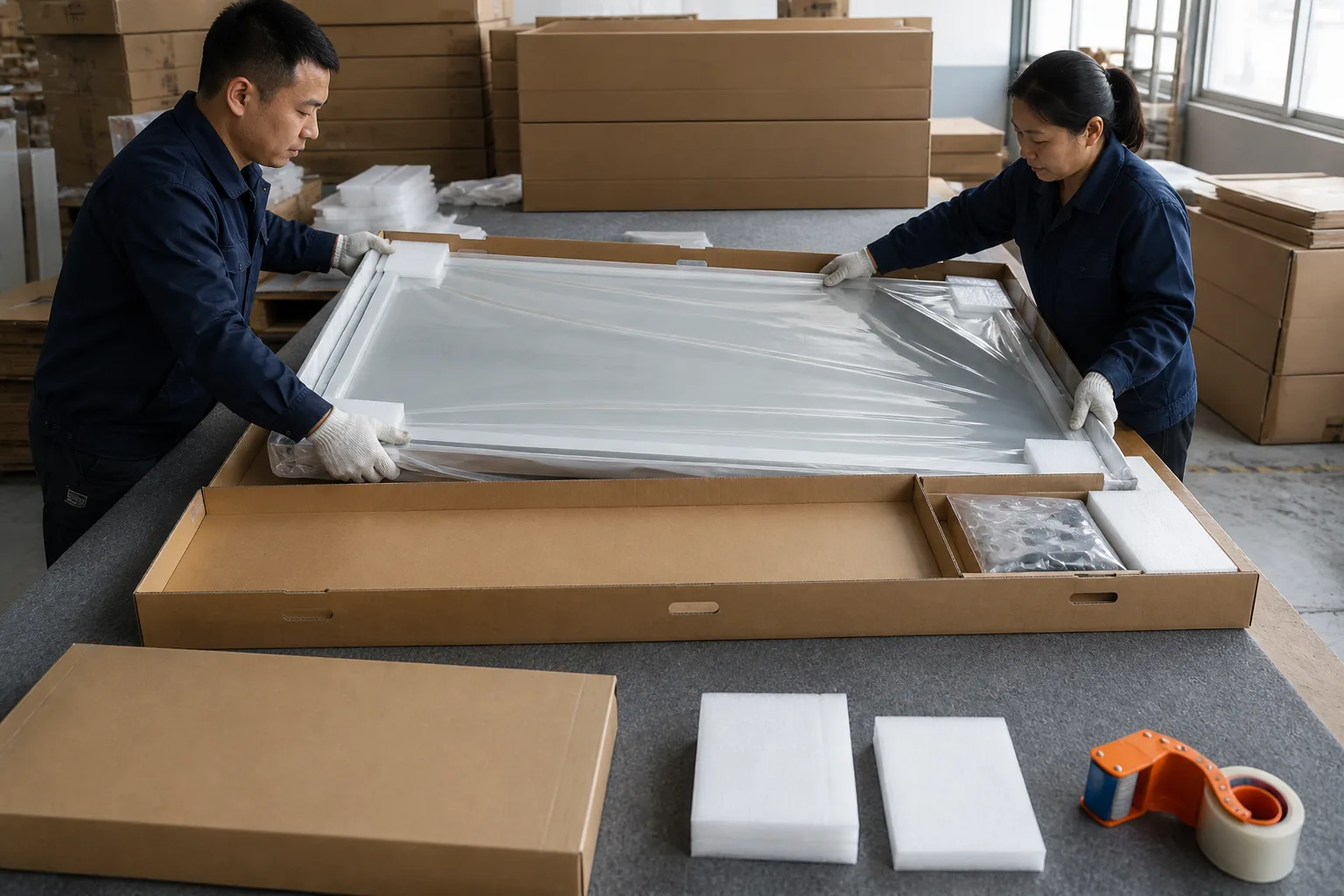
Match the packaging brief to the selected mirror
LED mirror export packaging should connect the exact product configuration to the handling route, protective structure, included parts and identification requirements. Jiachuang Mirror reviews that reference with the drawing and sample before order confirmation. Start with the product code, dimensions, shape, frame or edge, cabinet depth where relevant and accessory list. Identify the decision being requested: an early proposal, artwork review, packed-sample check or order-release reference. This prevents a general carton image from becoming an assumed specification for a different mirror.
Describe the distribution and identification route
Containerised wholesale shipments, parcel-based e-commerce delivery and room-by-room project supply have different handling and identification needs. State the intended channel and destination when requesting the proposal. A retailer may need consumer-facing product naming and barcodes, while a hotel or apartment project may need room, block or unit identification linked to an installation schedule. Keep those requirements tied to the selected model and quantity. For large project mirrors, also identify the access, handling and installation assumptions that must be reviewed for the selected size and destination.
Review protection separately from printed presentation
The protective structure addresses the mirror and the route; artwork addresses identity and communication. Review the face, edges, corners, rear components and movement risks for the selected construction. Include accessories and any parts that could move within the pack. A frame, cabinet depth or control component can change what needs protection, so do not assume every mirror uses an identical internal arrangement. Confirm the proposed protection and any test or report scope for that configuration. A printed handling mark or finished artwork file does not establish physical performance.
- Mirror face, edge, corner and rear-component protection
- Inner pack, accessory pack and movement control
- Selected shape, frame and relevant depth
- Supplier-confirmed protection and evidence scope
Create a label, instruction and artwork register
List the product label, rating or market label, consumer carton, outer carton, instructions, inserts, barcode data and project identification. Assign a content owner, market or language version, file revision and approval status to each item. Ask the supplier to return print-area constraints and required changes against the same revision. Keep electrical and certification wording provisional until the final model and destination requirements are confirmed. Product naming, model code and included-part descriptions should agree across the carton, instructions and approved product reference.
Use the physical packed sample to resolve questions
Review the actual pack as well as the artwork proof. Confirm that the selected product and accessories fit the agreed protection, that parts and instructions match the pack list, and that labels remain legible in their proposed positions. Where barcodes are used, the buyer should confirm the owner, type and encoded value, then check a physical printed sample. Review handling marks and project identification for the intended route. Record differences in one change list instead of approving the packaging through separate messages that refer to different revisions.
- Packed product, accessory count and instructions
- Protection fit and movement questions
- Artwork placement and label legibility
- Barcode scan result where applicable
- Carton identification and revision changes
Coordinate project packs with the room schedule
For hospitality and residential projects, connect packaging decisions to the room or unit schedule before release. Different mirror dimensions, orientations, controls or installation conditions should remain identifiable. Review room or block marking, included parts, spare-unit expectations and the relevant handling labels with the buyer responsible for receiving and installation. Reconcile the packaging reference with the final BOQ and approved product configuration. A carton identifier is useful only when it points to the same model and drawing used by the project team.
Release the product and packaging references together
Link the accepted carton structure, internal protection, labels, instructions, artwork and included accessories to the final model code, drawing and sample revision. Record open supplier-confirmation items explicitly. If sampling changes the product envelope, rear components or accessory list, review the pack reference again rather than carrying an earlier approval forward automatically. Final protection design, testing or report scope, market wording, price, MOQ, production schedule, warranty and delivery terms are confirmed for the selected configuration and written quotation. Keep the approved files together for inspection and repeat-order review.
| Match the packaging brief to the selected mirror | LED mirror export packaging should connect the exact product configuration to the handling route, protective structure, included parts and identification requirements. Jiachuang Mirror reviews that reference with the drawing and sample before order confirmation. Start with the product code, dimensions, shape, frame or edge, cabinet depth where relevant and accessory list. Identify the decision being requested: an early proposal, artwork review, packed-sample check or order-release reference. This prevents a general carton image from becoming an assumed specification for a different mirror. |
|---|---|
| Describe the distribution and identification route | Containerised wholesale shipments, parcel-based e-commerce delivery and room-by-room project supply have different handling and identification needs. State the intended channel and destination when requesting the proposal. A retailer may need consumer-facing product naming and barcodes, while a hotel or apartment project may need room, block or unit identification linked to an installation schedule. Keep those requirements tied to the selected model and quantity. For large project mirrors, also identify the access, handling and installation assumptions that must be reviewed for the selected size and destination. |
| Review protection separately from printed presentation | The protective structure addresses the mirror and the route; artwork addresses identity and communication. Review the face, edges, corners, rear components and movement risks for the selected construction. Include accessories and any parts that could move within the pack. A frame, cabinet depth or control component can change what needs protection, so do not assume every mirror uses an identical internal arrangement. Confirm the proposed protection and any test or report scope for that configuration. A printed handling mark or finished artwork file does not establish physical performance. |
| Create a label, instruction and artwork register | List the product label, rating or market label, consumer carton, outer carton, instructions, inserts, barcode data and project identification. Assign a content owner, market or language version, file revision and approval status to each item. Ask the supplier to return print-area constraints and required changes against the same revision. Keep electrical and certification wording provisional until the final model and destination requirements are confirmed. Product naming, model code and included-part descriptions should agree across the carton, instructions and approved product reference. |
| Use the physical packed sample to resolve questions | Review the actual pack as well as the artwork proof. Confirm that the selected product and accessories fit the agreed protection, that parts and instructions match the pack list, and that labels remain legible in their proposed positions. Where barcodes are used, the buyer should confirm the owner, type and encoded value, then check a physical printed sample. Review handling marks and project identification for the intended route. Record differences in one change list instead of approving the packaging through separate messages that refer to different revisions. |
| Coordinate project packs with the room schedule | For hospitality and residential projects, connect packaging decisions to the room or unit schedule before release. Different mirror dimensions, orientations, controls or installation conditions should remain identifiable. Review room or block marking, included parts, spare-unit expectations and the relevant handling labels with the buyer responsible for receiving and installation. Reconcile the packaging reference with the final BOQ and approved product configuration. A carton identifier is useful only when it points to the same model and drawing used by the project team. |
| Release the product and packaging references together | Link the accepted carton structure, internal protection, labels, instructions, artwork and included accessories to the final model code, drawing and sample revision. Record open supplier-confirmation items explicitly. If sampling changes the product envelope, rear components or accessory list, review the pack reference again rather than carrying an earlier approval forward automatically. Final protection design, testing or report scope, market wording, price, MOQ, production schedule, warranty and delivery terms are confirmed for the selected configuration and written quotation. Keep the approved files together for inspection and repeat-order review. |