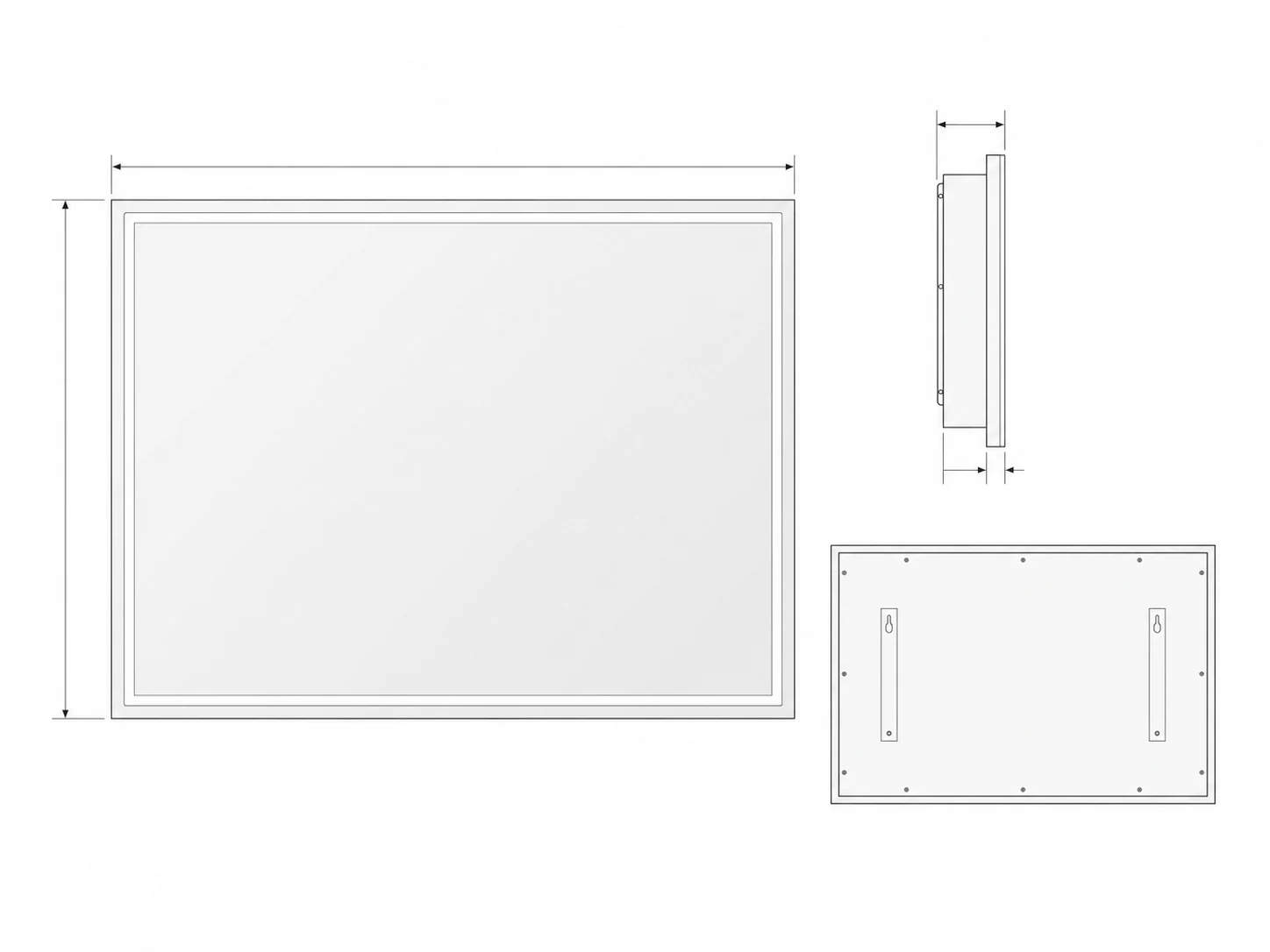


Start with the buyer decision the drawing must support
A drawing for early feasibility review is not the same as a production-release drawing. State whether the buyer needs a concept review, quotation comparison, sample proposal or final engineering check. Add the product family, application, destination market and responsible reviewer so each supplier reads the same brief.
- Decision stage and requested next step
- Product or visual reference
- Application and destination market
- Buyer drawing number, revision and reviewer
Dimension the product envelope first
Show overall width and height, orientation, frame or edge condition and any depth that affects the wall relationship. Relate the mirror to the vanity, basin centres, wall edges and nearby fittings when those interfaces drive the visible result. Use millimetres or inches consistently and state whether dimensions are targets, limits or reference values.
- Overall width, height and relevant depth
- Orientation and visible edge or frame condition
- Vanity, basin and wall relationship
- Unit, scale and target-versus-limit status
Locate the visible and functional zones
Add the position and extent of front-light lines, backlit clearance, control icons, anti-fog intent and any sensor or accessory zone. These callouts should describe the intended relationship rather than assume an unverified component layout. Ask the supplier to return conflicts that arise from the selected shape, dimensions or construction.
- Light-zone offsets and continuity
- Control and indicator centre lines
- Intended anti-fog clear zone
- Areas that must remain visually uninterrupted
Coordinate power, mounting and wall interfaces
Show the intended cable-entry or junction location, mounting reference points, wall build-up and required clearances. Identify whether switching is integrated, wall controlled or still open for review. Final electrical construction, mounting hardware and destination-market compliance remain subject to the selected configuration and supplier engineering confirmation.
- Power-entry or junction reference
- Mounting points and installation datum
- Wall condition and service clearance
- Control assumption and items for confirmation
Separate buyer requirements from supplier confirmation
Use a simple status beside each important callout: required, preferred, reference or supplier to confirm. This prevents a reference image, preliminary position or estimated clearance from becoming an accidental production instruction. Record questions directly on the revision or in a linked comment schedule.
Package the RFQ files so suppliers can answer consistently
Send the drawing with the relevant visual reference, quantity direction, destination market and requested response. Ask suppliers to identify assumptions, conflicts and proposed changes against the same revision. Price, MOQ, production schedule, warranty, certification or report scope and final dimensions are confirmed only for the selected configuration and written quotation.
- Editable or readable drawing plus PDF
- Reference image or product direction
- Quantity direction and destination market
- Requested output: feasibility, quotation, sample or revised drawing